 Parental Rights
by Nicki Blake
‘What do you mean ‘wants it back’?’
‘Well she never officially gave it to us so it still belongs to her.’
‘Did you tell her she won’t want to look at it? That it doesn’t look like a baby at all, if that’s what she’s thinking.’
It had been curled in the side of the abdominal cavity — hard, yellow-white like old ivory. Slick with blood and tissue, it glistened under the operating-theatre lights. A few swift scalpel strokes and it came away like a rotten tooth.
‘She doesn’t care,’ continued Garcia, ‘She’s within her rights. She wants to give it a Christian burial.’
‘Rights!’ snapped Carstairs.
‘Don’t you start,’ she replied. ‘You’re not the one who has to trace a lost medical rarity when there are a hundred more important things I could be doing.’
‘Why don’t you leave it with me?’ Carstairs offered, ‘Doubtless it’s been mislabelled and misplaced. You know what those idiots in the path-lab are like. I’ll deal with the mother too.’
‘Only if you’re sure,’ Garcia was already shoving the clipboard into Carstairs’ hands, leaving him standing alone in the office as she strode away from the responsibility. Carstairs waited five minutes after her departure before informing his receptionist he was unwell and would be out of the office for the rest of the day.
He broke the speed limit all the way home.
His house was a silent contrast to the noise and activity of the hospital. He dropped his briefcase in the hall, entered the living room — another contrast, it being lined with dark wooden shelves crammed with antique books and softly lit by table lamps, unlike the bare, white fluorescent glare of the hospital corridors.
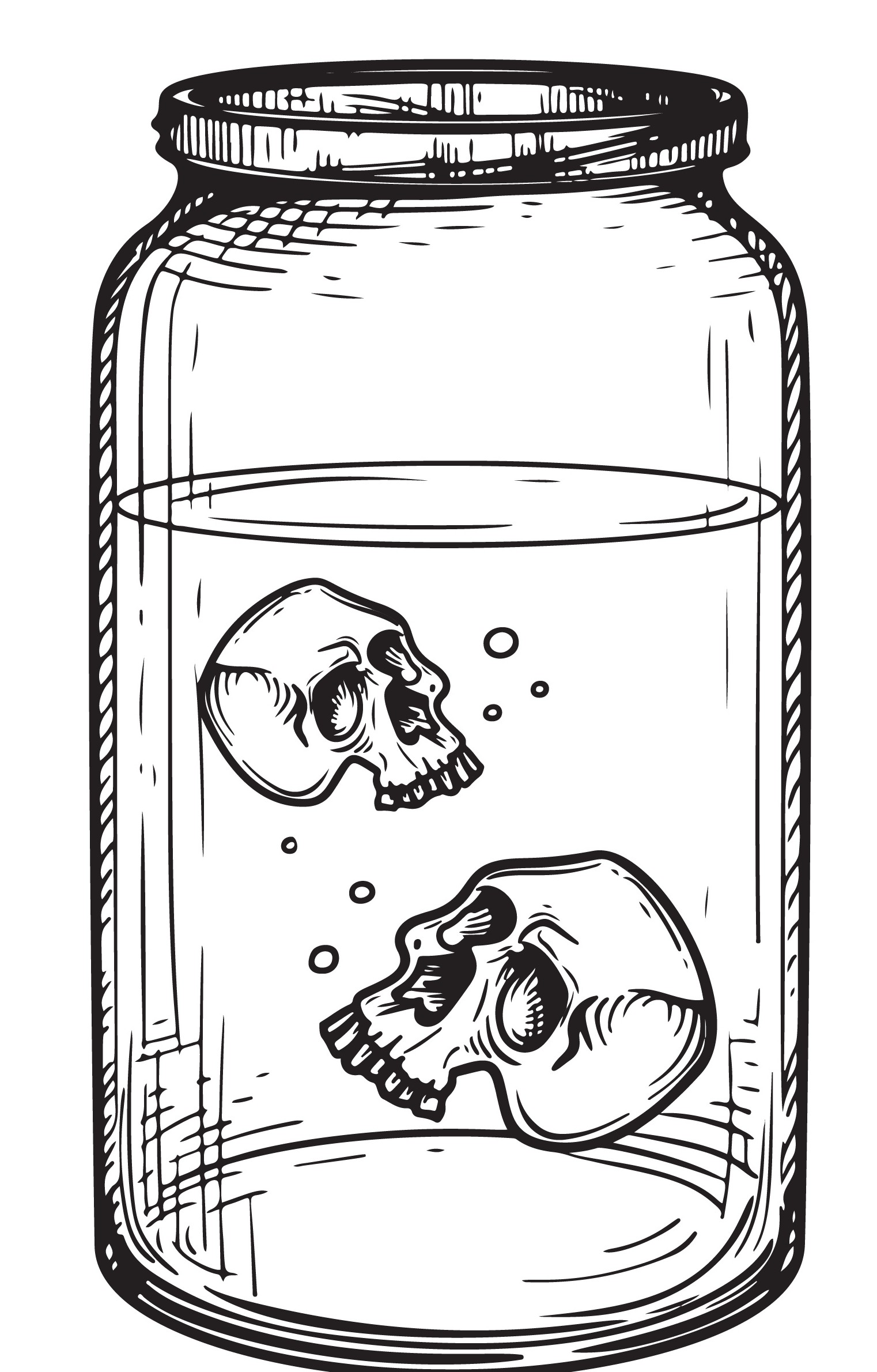
A Louis XVI vitrine cabinet standing between two bookshelves displayed his collection. He’d installed lights inside it — nothing too excessive or which would depreciate it, but enough to properly illuminate the array of jars where the babies floated in preserving liquor — cheeks and hands squashed against the glass. Some had their eyes open, some had no eyes at all. Others were cojoined twins, or anencephalic specimens. He had a couple of excellent teratoforms he’d picked up from a defunct anatomy museum in Switzerland, some rarer pieces bought on the private market, and a few of them he’d obtained through his own work, which included his latest find.
It lay on a folded cotton towel on the centre shelf. He’d cleaned it quickly while at the hospital but, once home, had taken more care, polishing its cold form until it was pristine, before making the only cot it would ever know. Its eyes and mouth, round hollows in a misshapen skull, gave it a look of surprise. It reminded him, oddly, of the mother.
She’d been an older woman, early sixties — face deeply-lined from years of ill-health, wide-eyed as her relief at not having cancer gave way to confusion when Carstairs explained the reality of the mass on the tomography image.
‘We call it a lithopedion,’ he’d told her, ‘It means ‘stone baby’. It was a pregnancy which developed outside your womb, by our estimation, some twenty or more years ago. The body’s defence system calcifies it, a bit like an oyster defends itself from sand by making a pearl. It’s amazing no one picked up on it before, but it is an extremely rare occurrence. We’ll operate to remove it then, with your permission of course, we’d like to study its pathology. You’re fortunate this is within my field of expertise.’
He’d been so certain she’d give permission, he hadn’t waited. The lithopedion left the hospital with him that evening.
Now she wanted it back.
He dropped into a chair, pulling a book from the shelf. He flipped through the foxed pages, scanning the contents for the words he wanted.
It was a whisper at first, then a chant. The ancient language echoed through the quiet house. When the cabinet lights flickered, he slowed for a moment before increasing his volume. In one of the jars, a bubble of air formed on the lips of a blind foetus, and drifted upwards.
Encouraged, Carstairs continued, his gaze flicking from page to specimens. The movements were slight, but they were real – tiny fingers flexed and pressed against their glass prisons, cloudy eyes blinked.
The lithipedion quivered.
Carstairs enunciated more precisely, the unfamiliar words contorting his mouth as he struggled with the pronunciation. After he’d recited a few more lines, he saw the stone-skin ripple like liquefying wax.
He set down the book, crouching beside the cabinet.
Its face had changed — the eyes screwed up, the mouth pursed. He heard a soft hitched breath, one he recognised from his years in delivery rooms — that first independent breath which, all being well, would be followed by the first cry.
He waited.
It came — thin and shrill, not the cry of a child, but something more akin to a wounded animal, one that was suffering.
Carstairs extended a fingertip, touching the small twisted spine, offering comfort, but the moment he connected with it, the lights extinguished and he found himself in the dark, touching skin which was once more stiff with age and cold.
‘Damn!’
It had been the same every evening since he’d brought it home. He’d tried several books, several methods, but none of them had a lasting result. He surveyed the shelves — the books numbered in the hundreds, many of them ancient and with more disquieting contents than the one he’d just trialled. There was no way the lithopedion could be returned, not when there were so many rites left to try.
Parent or not, she didn’t deserve it — not if she was going to bury it, re-consigning it to darkness once more.
‘Rights!’ he huffed, switching the light back on.
He selected a different book and resumed his position on the chair.
He started to recite.